In partnership with the Washington and Lee University Library, Frances Richardson and the Central Virginia Fiber Guild assembled a digital exhibit on weaving history in 19th-century Rockbridge county, including reproductions of the original patterns.
As our e-Newsletters roll out this series in the coming months, please check back in to see what new materials we’ve added. You can click hotlinks to access sites, or download full articles. Please Contact Us with your Questions, or suggestions for additions, or to add join the email list for latest releases, additions, and notice of relevant events.
Note: Resources with an * have been produced in conjunction with RHS Programs or Publications.
Qualified Colored Electors for Rockbridge County, 1867
Black men in Virginia voted for the first time in October 1867. The purpose of the election was to determine if a state constitutional convention should be held, and if so, to select the delegates. The convention first met in December 1867, and the delegates would draft the new post-Civil War constitution in Virginia, that would remain in effect until 1902. The broader context for that election is explained on the Library of Virginia’s Virginia Memory website:
“In the spring of 1867, Congress passed the Act to Provide for the More Efficient Government of the Rebel States, often called the First Reconstruction Act. It required the former Confederate states to ratify the Fourteenth Amendment before their representatives and senators could be seated in Congress. It also required the states to hold conventions, in which African Americans were eligible to serve, and to write new state constitutions. In Virginia, African Americans, former Unionists, and men who had settled in Virginia during and after the war organized to prepare for the election. Officers of the U.S. Army oversaw the registration of voters. On October 22, 1867, African American men voted in Virginia for the first time. The army officers who conducted the election recorded the votes of white and black men on separate lists and in some or all of the counties and cities required voters to place their ballots in separate ballot boxes.”
The Library of Virginia has digitized images of the hand-written rosters chronicling the 952 black men in Rockbridge County who voted. The list is organized by the county’s seven districts at the time, with Lexington as the 1st District. The boundaries for the districts are set out in a color-coded 1860s Rockbridge Map made by Colonel William Gilham of VMI; it can be accessed at the Library of Congress website HERE.
To see the scans, click HERE and search “Rockbridge Electors.”
Because the images are difficult to read, divided in seven separate documents, and not searchable as scans, you can access the names in an Excel spread sheet transcribed HERE.
The names are set out in alphabetical order, and you can also use the search function to locate last or first names, locate by district, identify those voters who were free men before the Civil War, and those who appear in the 1870 Census. While most of these first-time electors had been previously enslaved, and emancipated during or after the War, at least 59 men listed as free blacks in the 1860 Census appear here (of over 1,000 registered black voters in Rockbridge, approximately 91% cast their ballots on Oct.22, 1867).
The Rockbridge Historical Society is working with a group of local historians and genealogists to develop additional online resources in this area. In their more comprehensive reach, and more accessible digital formats, they will allow researchers, students, family descendants, and the public at to more fully and flexibly explore the range and specific identities of African-American lives in Rockbridge, in this era. These web-based archives will include a comprehensive database of free black men and women before 1860. And by complement: a multi-tiered spreadsheet that provides a systematic, county-wide inventory of people enslaved in Rockbridge, mapped to locations of ownership, and individually searchable: whether by first name, surname, or anonymously recorded.
The RHS website at RockbridgeHistory.org has also established a broader portal for ‘Local Black Histories,’ with articles that feature profiles and photographs of some of these electors: such as Lilburn Downing, James Humbles, Wilson Pleasants, William Washington.
Wilson Pleasants, First Baptist Deacon, b.1845
People with additional biographical information, particularly descendants, are encouraged to contact RHS@RockbridgeHistory.org, to help refine these valuable local history resources over time.
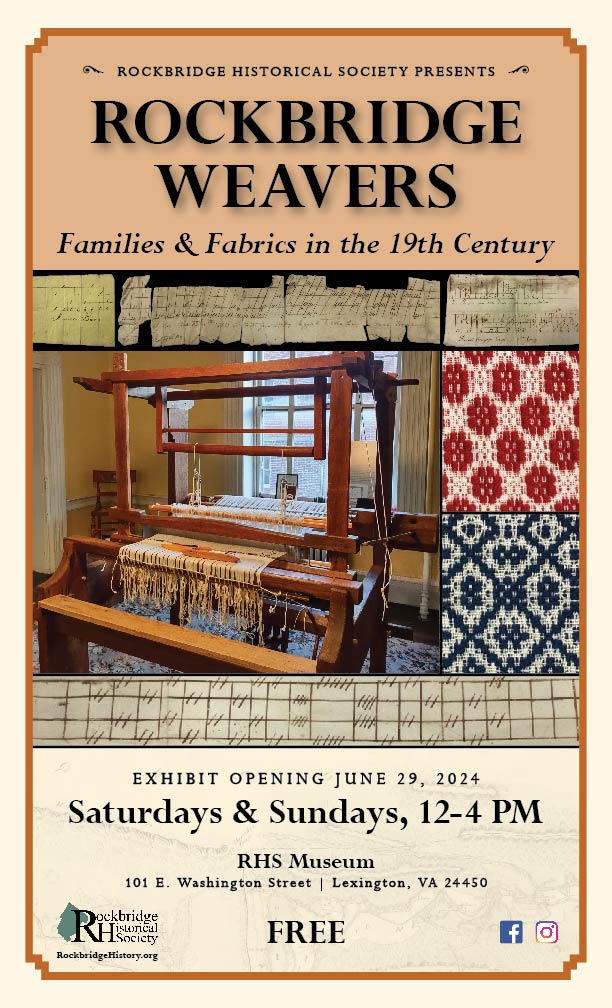
Rockbridge Weavers: Families & Fabrics in the 19th Century
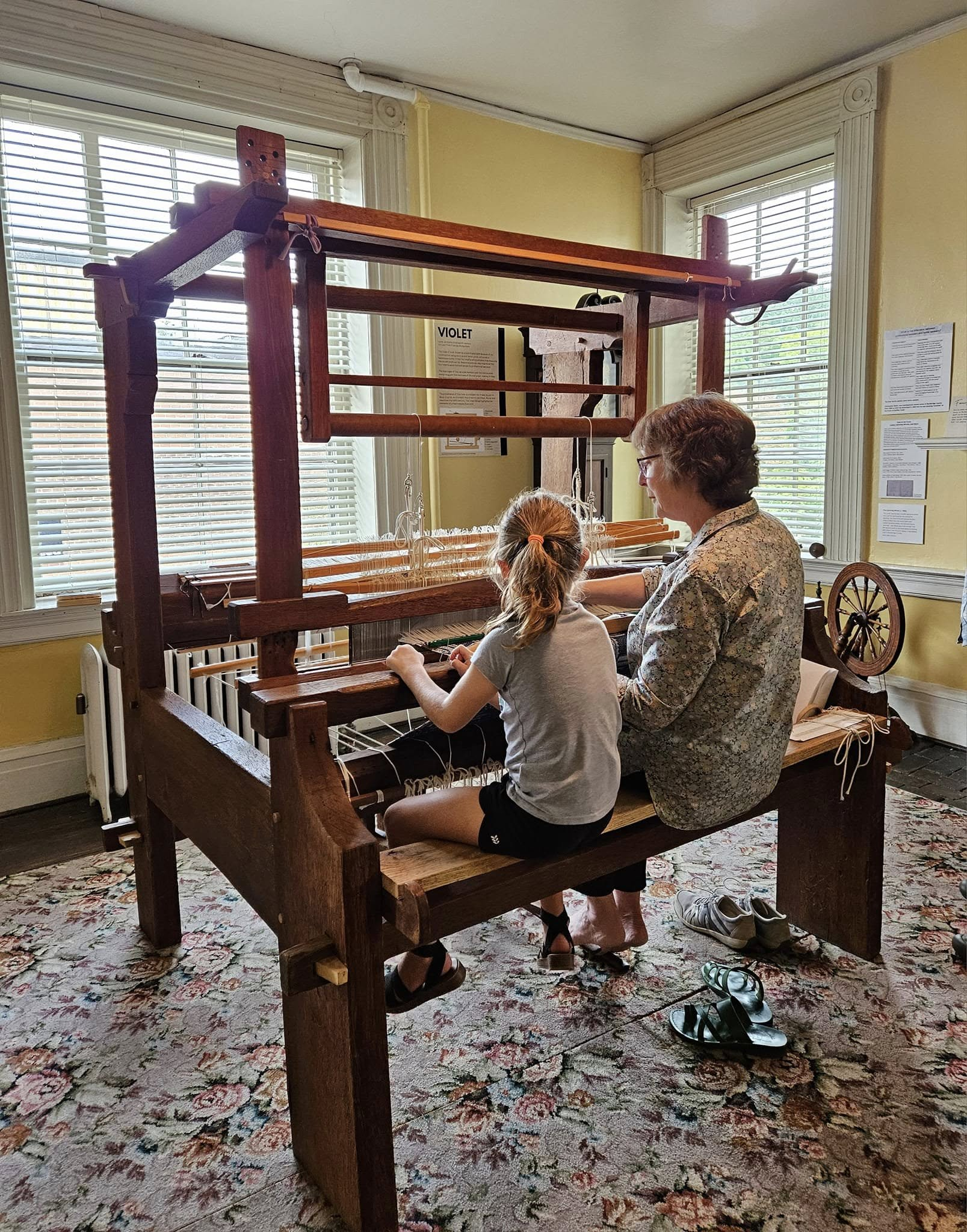
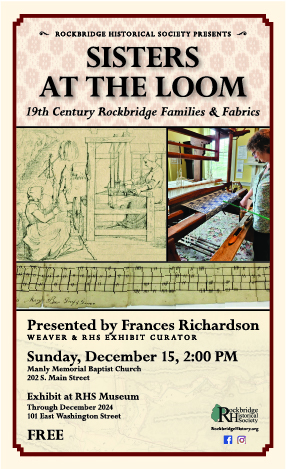
“ROCKBRIDGE WEAVERS,” curated by Frances Richardson, is free and open to the public on weekends at the RHS Museum through December 2024 (Saturdays and Sundays, 12-4, 101 E. Washington St.). The origins of this project – archival and artisanal alike – drew from the discovery of early 19th century weaving patterns preserved on small scraps of paper held at Washington & Lee, and shared with friends and family. More broadly, this representative group of “ordinary women, with extraordinary skills,” further highlights a range of everyday connections, financial exchanges, and social networks linking the farmsteads and stores near “Panther Gap” (near Goshen, in the northwestern corner of Rockbridge).
Displays of period samples held in RHS Collections, and explanations of historic techniques, are complemented by displays, samples, and reflections shared by Richardson and a wider group of fellow “Sisters at the Loom.” Through their own craft and curiosities, they have used these particular patterns, inked and pinned by local hands two centuries ago, to create contemporary and often colorful reproductions of their own.
At the museum (or on this video feature by Rockbridge Report), you can see live demonstrations on Richardson’s 6-foot antique loom. You can also learn about these histories virtually, via an online exhibit developed by staff in W&L’s Special Collections Archives and Digital Humanities Division.
Sunday, March 10, 3-5 PM
Lexington Community Center
300 Diamond Street
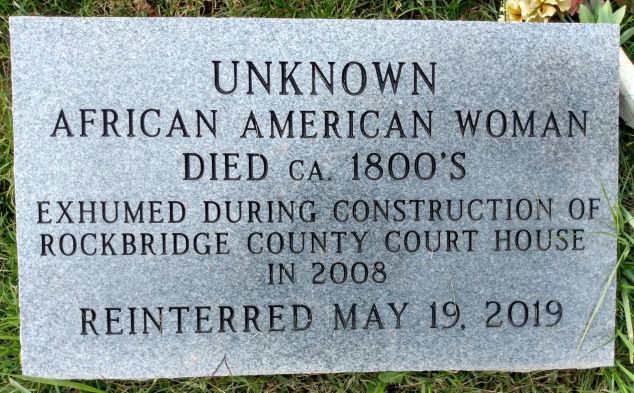
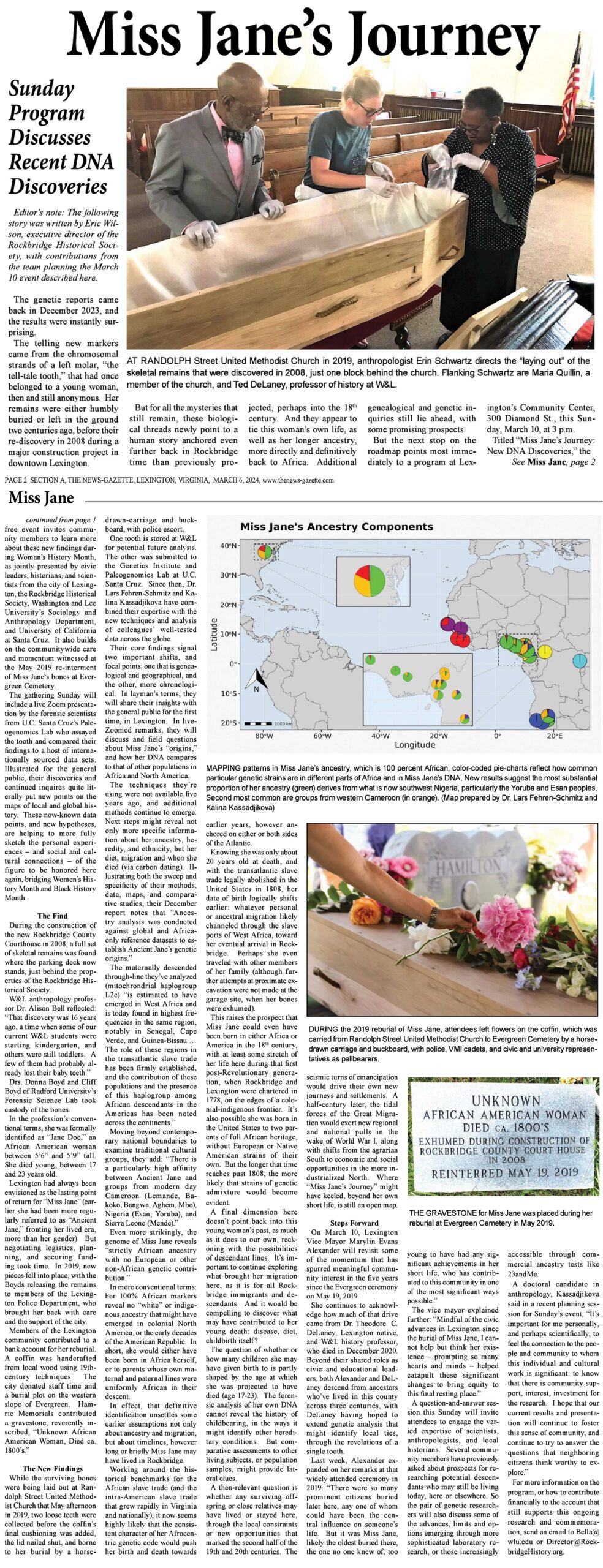
In 2008, a set of skeletal remains was found in downtown Lexington, determined to be those of a woman of African descent, who died young, sometime in the 19th-century. In a civic ceremony in 2019, the bones of “Miss Jane,” were re-interred in Evergreen Cemetery. In late 2023, new DNA analysis revealed some surprising genetic findings. This data now spurs new questions about her heredity, the migration patterns and timetables that may have brought her to this area, and the broader ‘journeys’ of any descendant lines who may have remained here, or moved on.
During Women’s History Month, join the City of Lexington, the Rockbridge Historical Society, Washington & Lee University Dept. of Anthropology, and the Paleogenomics Lab at the University of California, Santa Cruz to hear more about these findings, pose questions to both scientists and historians, and to seed community conversation, ahead. Sunday, March 10, 3 PM; Lexington Community Center, 300 Diamond Street. For more, see RHS Facebook @rockbridgehistory.
Sisters at the Loom: 19th Century Rockbridge Families & Fabrics
Sunday, December 15, 2:00 PM Manly Memorial Baptist Church 202 S. Main St., Lexington
Cap RHS’ 85th year with a deeper dive into our 2024 Exhibit, which was curated by our year’s final presenter, Frances Richardson. Her illustrated slideshow will discuss the origins of a project: drawn from the early 19th century weaving patterns inked onto small scraps of paper, shared with friends and family, and now preserved at Washington & Lee, and. More broadly, the representative group of “ordinary women, with extraordinary skills,” further highlights a range of everyday connections, financial exchanges, and social networks linking the farmsteads and stores near “Panther Gap” (near Goshen, in the northwestern corner of Rockbridge). Richardson will also discuss how these traces of material culture have helped to shape her own curiosities and practice as a weaver, joined by a wider group of fellow “Sisters at the Loom,” who have used these historic patterns – scripted and pinned by local hands two centuries ago – to create contemporary and often colorful reproductions of their own.
The complementary exhibit, “ROCKBRIDGE WEAVERS” remains open on weekends at the RHS Museum through December 2024 (Saturdays and Sundays, 12-4, 101 E. Washington St.). There, you can see live demonstrations on Richardson’s 6-foot antique loom. You can also learn about these histories virtually, via an online exhibit developed with staff in W&L’s Special Collections Archives and Digital Humanities Division. A video feature by the Rockbridge Report gives you a further glimpse of the displays and design, and clips of the weaving process, itself.
Before the featured presentation, outgoing President Larry Spurgeon will introduce the nominees for next team of RHS Officers, and provide an overview of proposed revisions to the RHS Constitution and By-Laws (you can review those updates, approved by the Board in November, HERE.Our contributing members are invited to vote for adoption of those recommendations, as well as the proposed Officer slate for 2025-2026: President, Tom Roberts; Vice President, Julie Goyette; Secretary, Cathy DeSilvey; Treasurer, Stephanie Hardy.